
How to Avoid Common Mistakes in Swing Trading: A Beginner’s Guide for Indian Traders
Swing trading looks simple from the outside. You buy a stock, hold it for a few days or weeks and sell once the price has moved. Yet most beginners in India struggle in their first year, and the reason is rarely a bad stock pick. It is usually a handful of avoidable habits: trading without a stop-loss, taking oversized positions, chasing prices and entering trades with no written plan.
This guide explains the ten most common swing trading mistakes made by Indian beginners and shows how to fix each one with a clear rule. You will also find position sizing charts, an entry checklist, practical tips and answers to the questions traders ask most often.
01What Are the Most Common Mistakes in Swing Trading for Indian Beginners?
- Decide the stop-loss first and place it where the trade idea is proven wrong.
- Risk a fixed 1–2% of trading capital per trade and calculate quantity from the stop distance.
- Trade liquid stocks on daily charts and keep your indicator list short.
- Write a one-page plan, test it on past charts and follow it every time.
- Keep a journal so every mistake turns into a rule.
02What Is Swing Trading and Why Do Beginners Struggle?
Swing trading holds a position for a few days to a few weeks to capture one directional price move, called a swing. Intraday traders close positions the same day, while investors hold for years. A swing trader sits in between and uses daily charts to find a trend or range. If you are starting from zero, read this guide on how to learn swing trading in India for a step-by-step foundation.
| Feature | Intraday trading | Swing trading | Long-term investing |
|---|---|---|---|
| Holding period | Minutes to hours, closed the same day | A few days to a few weeks | Years |
| Main chart | 1, 5 and 15 minutes | Daily, with weekly for context | Weekly and monthly |
| Screen time | Constant during market hours | Once or twice a day | Occasional |
| Overnight gap risk | None if squared off | Yes, so a stop-loss is essential | Yes, part of the plan |
| Fit for beginners with a job | Low | High | High |
Why beginners struggle
Three problems show up again and again. First, swing trades are held overnight, so a bad opening can skip past your exit price. Second, emotion takes over: fear makes people sell winners early, and hope makes them hold losers too long. Third, most beginners have no process. They buy because of a tip, a headline or a green candle and have no rule for what to do when the trade goes the other way.
03The 10 Mistakes at a Glance
| Mistake | What goes wrong | The fix |
|---|---|---|
| 1. No stop-loss | One gap or bad trade wipes out weeks of profit | Set the stop below the last swing low before entry |
| 2. Oversized position | A single loss hurts the whole account | Risk 1–2% and size from the stop distance |
| 3. Illiquid stocks | Poor entry price, hard exits, circuit traps | Stick to liquid large and mid-cap stocks |
| 4. Wrong time frame | Noise on 1 to 15 minute charts | Use daily and weekly charts |
| 5. Too many indicators | Conflicting signals and confusion | Price first, then two or three tools |
| 6. Chasing breakouts | Late entry, wide stop, poor reward | Use a clear breakout or pullback trigger |
| 7. Ignoring events | Results gap through the stop | Check the results calendar before entry |
| 8. Moving the stop away | Small loss turns into a big one | Move stops only in the direction of profit |
| 9. No tested plan | Random trades and copied tips | Write, backtest and paper trade a plan |
| 10. Overtrading | Revenge trades and weak setups | Cap open trades and pause after losses |
0410 Common Swing Trading Mistakes and How to Fix Each One
Mistake 1: Trading Without a Stop-Loss
A swing trade stays open overnight, so a gap-up or gap-down can open far from the previous close. Without a stop-loss, one bad trade can erase weeks of profit. Beginners skip the stop because they hope the stock will recover or because they never decided where the idea is wrong.
How to fix it: Decide the exit before you enter. For a long trade, place the stop just below the most recent structural swing low, not at a random percentage. If the stop has to be so far away that your position size shrinks to almost nothing, skip the trade. For a full method, see this guide on how to manage risk and stop-loss in swing trading.
Mistake 2: Risking Too Much Capital on One Trade
Many beginners size a position by how confident they feel. A “sure thing” gets half the account, and a single stop-out becomes painful. Position size should come from the stop distance, not from conviction.
How to fix it: Risk a fixed 1–2% of total trading capital per trade and use this formula: Quantity = Amount you can lose ÷ (Entry price − Stop price). With ₹2,00,000 and 1% risk, you can lose ₹2,000. Buy at ₹500 with a stop at ₹480 and the risk per share is ₹20, so you buy 100 shares. The charts later in this guide show why this one rule protects your account.
Mistake 3: Choosing Illiquid or Low-Quality Stocks
Thin volume and wide bid-ask spreads mean a poor price on entry and an even worse price when you need to leave quickly. Tip-driven small caps can also hit circuit limits and trap you in a position you cannot sell.
How to fix it: Build a watchlist from liquid large-cap and mid-cap stocks, such as constituents of the Nifty 50 and Nifty Next 50. Keep stocks with healthy daily volume and a clear trend or range, and rebuild the list every week. This walkthrough on how to select stocks for swing trading explains the filters step by step.
Mistake 4: Using the Wrong Chart Time Frame
One-minute, five-minute and fifteen-minute charts are too short for a swing to develop. They suit intraday traders who must square off by the end of the day. Beginners who study them for swing trades see noise instead of trend.
How to fix it: Start with the daily chart to find the primary trend. Add the weekly chart for context and, if needed, the hourly chart to time the entry. Because Indian markets close at 3:30 PM, you can review charts calmly after the close instead of reacting to every tick.
Mistake 5: Cluttering Charts With Too Many Indicators
Stacking RSI, MACD, stochastic, Bollinger Bands and Supertrend on one chart produces conflicting signals. The trader freezes or, worse, picks whichever indicator agrees with what they already want to do.
How to fix it: Let price lead. Use no more than two or three tools, such as the 20-day and 50-day moving averages, RSI (14) and volume. Learn how each behaves on the stocks you trade and ignore the rest.
Mistake 6: Chasing Breakouts and Entering Late
Fear of missing out pushes beginners to buy after a stock has already moved sharply. Late entries leave a small remaining reward and a stop far below the price, which ruins the risk-to-reward ratio.
How to fix it: Pick one of two clear triggers. A breakout entry waits for a decisive close above resistance, ideally on higher volume. A pullback entry waits for price to retrace toward support or a rising moving average inside an uptrend and show signs of turning up. If you miss the trigger, wait for the next setup. Read more on how to identify swing trading entry and exit points.
Mistake 7: Holding Through Results and Major Events Blindly
Quarterly results, policy announcements, the Union Budget and global events can cause overnight gaps that blow straight through a stop-loss. Beginners often forget the date until the stock opens 6% lower.
How to fix it: Check the results calendar on the NSE or BSE website before entering. Reduce your size or exit before the event if that risk is not part of your plan. Do not rewrite a trade plan because of a headline.
Mistake 8: Moving the Stop-Loss Further Away
When a trade moves against them, many traders widen the stop to avoid taking the loss. This turns a small, planned loss into a large, unplanned one.
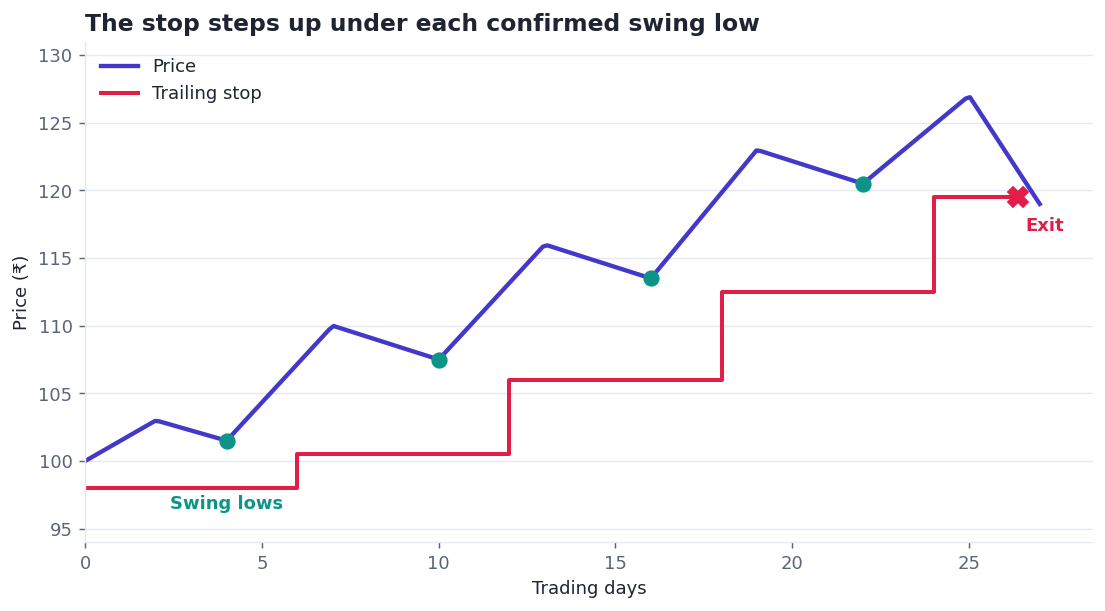
How to fix it: A stop-loss may only move in the direction of profit. As the trade works, trail it up to just below each new higher swing low. Many traders also book partial profit at a first target and trail the stop on the rest.
Mistake 9: Trading Without a Tested Plan
Strategies copied from social media or messaging groups rarely fit your schedule, capital or temperament. A strategy that is never tested is only an opinion.
How to fix it: Write a one-page plan covering what you trade, your entry trigger, stop-loss, position size, target and exit. Test it on past charts of the stocks you follow, then paper trade at least 20 setups before using real money. Stay away from unregistered tipsters and confirm that any advisor is registered with SEBI. To compare approaches, read what is your swing trading strategy.
Mistake 10: Overtrading and Revenge Trading
After a loss, the urge to win the money back immediately is strong. After a few wins, some traders take trades just because they feel on a roll. Both habits lead to larger positions, weaker setups and bigger losses.
How to fix it: Limit the number of open positions, limit the total capital at risk across all open trades and write both limits in your plan. After two or three losses in a row, stop trading for a day and review your journal before placing another order.
05Position Sizing and Risk Charts
Most of the fixes above come back to risk control. A safe trade follows the same order every time.
Chart 1: A swing trade with a 1:2 risk-to-reward
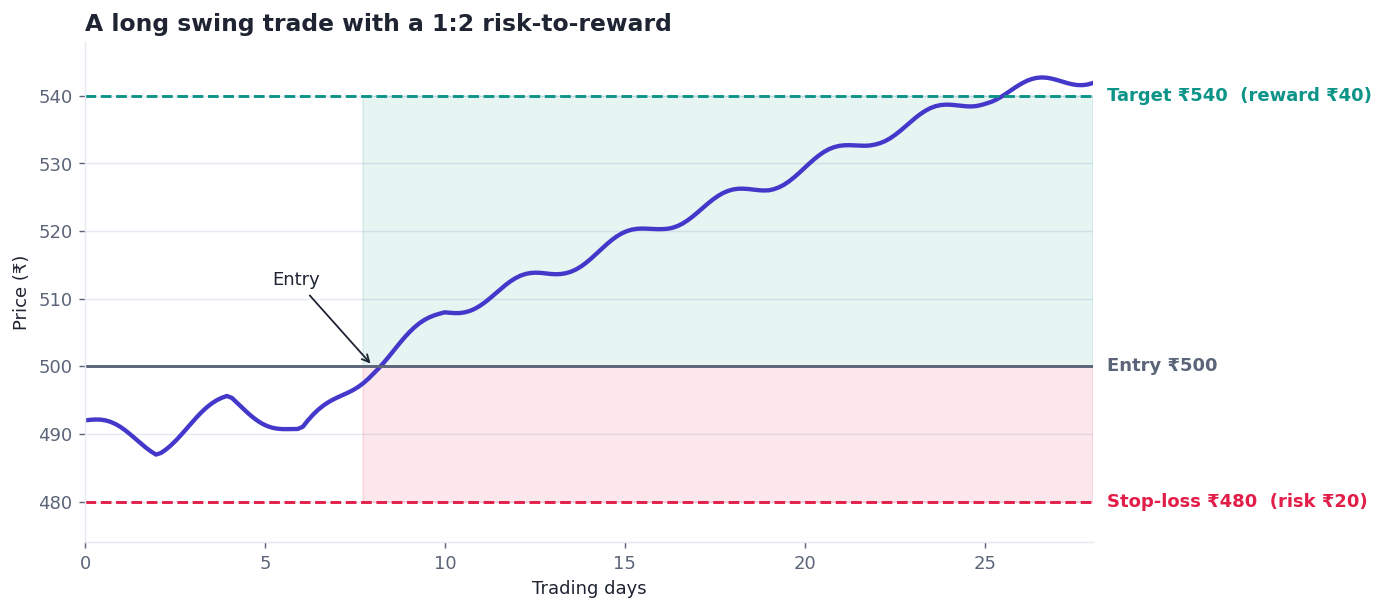
At a 1:2 ratio you can be right less than half the time and still stay profitable, as long as you honour your stop on every losing trade.
Chart 2: What a losing streak does to your capital
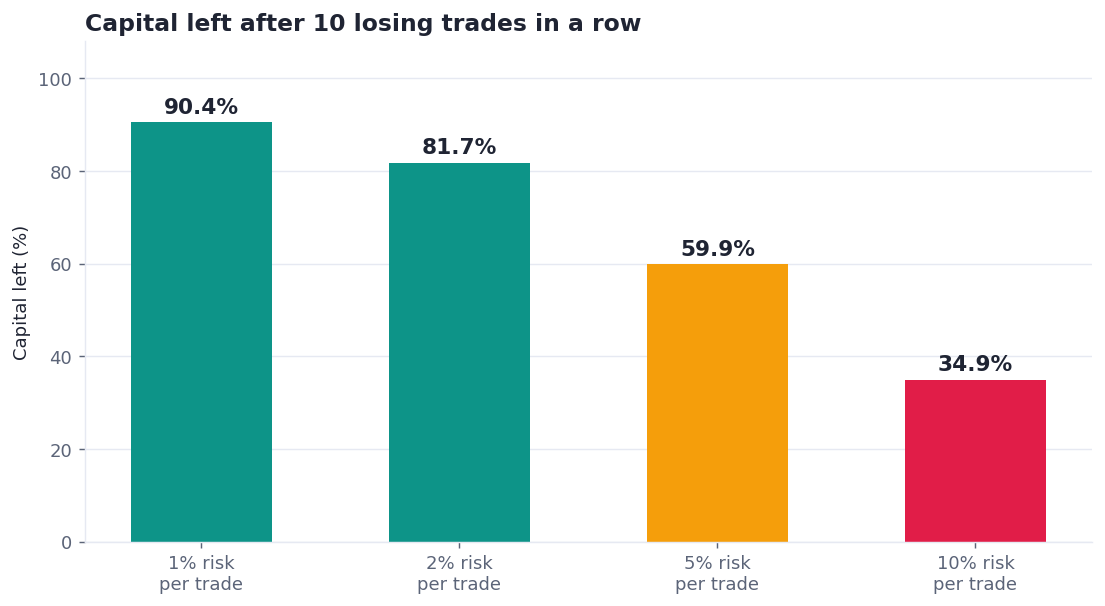
| Risk per trade | Capital left after 10 straight losses | Gain needed to get back to start |
|---|---|---|
| 1% | 90.4% | 10.6% |
| 2% | 81.7% | 22.4% |
| 5% | 59.9% | 67.0% |
| 10% | 34.9% | 186.8% |
At 1–2% risk, a long losing streak is painful but recoverable. At 10% risk, the same streak leaves you needing to nearly triple what is left. This is why position sizing is the single most important habit for a beginner.
Worked example: same trade, two risk levels
| Item | 1% risk | 2% risk |
|---|---|---|
| Trading capital | ₹2,00,000 | ₹2,00,000 |
| Amount you can lose | ₹2,000 | ₹4,000 |
| Entry and stop-loss | ₹500 and ₹480 | ₹500 and ₹480 |
| Risk per share | ₹20 | ₹20 |
| Quantity | 100 shares | 200 shares |
| Position value | ₹50,000 (25% of capital) | ₹1,00,000 (50% of capital) |
| Target at 1:2 | ₹540 | ₹540 |
A tight stop lets position value grow quickly. Always check that the total amount invested is not too large a share of your capital, even when the risk per trade is small.
Chart 3: Trailing the stop-loss
06Swing Trade Entry Checklist
Run through this five-point check before every order. If any answer is no, skip the trade.
| Check | Question to ask |
|---|---|
| 1. Candidate | Is the stock liquid, and is the trend or range clear on the daily chart? |
| 2. Entry trigger | Has the breakout closed above resistance, or has the pullback shown signs of ending? |
| 3. Stop-loss | Is the stop at a structural point on the chart, and was it decided before entering? |
| 4. Position size | Does a stop-out cost roughly 1–2% of your trading capital, not more? |
| 5. Exit plan | Do you know your first target and how you will trail the remaining position? |
07Tips and Tricks for Indian Swing Traders
Set up your routine
- Review charts after the 3:30 PM close. Make decisions when the market is shut, not while prices are moving.
- Keep a short watchlist of 10 to 20 liquid stocks. A small list is easier to know well than a long one.
- Check the results calendar and upcoming events every weekend.
- Build the routine around your job. This guide on how to do swing trading while working shows how to fit trades around office hours.
Place orders the smart way
- Use delivery orders for swing trades. Intraday product types are squared off automatically by the broker at the end of the day.
- Use GTT or stop-loss orders offered by your broker so the exit is placed in advance. Read how to swing trade stocks without watching the market all day.
- Avoid futures and options until your cash-market process is consistent. Leverage magnifies every mistake in this guide.
- Count your costs. Brokerage, taxes and other charges reduce returns, and frequent trades add up.
Build the right mindset
- Judge yourself on the process, not on whether a single trade made money.
- Keep a trade journal with the entry reason, stop, target, result and one lesson. Review it every week.
- Use volume as confirmation. A breakout on strong volume is more reliable than one on thin volume.
- Never add to a losing trade to lower your average price.
08A 30-Day Plan to Stop Making These Mistakes
| Week | Focus | What to do |
|---|---|---|
| Week 1 | Learn the structure | Study support and resistance, trends and the two entry triggers on daily charts of 10 liquid stocks. |
| Week 2 | Write your plan | Define entry, stop, size, target and exit on one page. Test it on past charts. |
| Week 3 | Paper trade | Log 10 or more practice trades with exact entries, stops and position sizes in a journal. |
| Week 4 | Review and start small | Study your journal. If the rules were followed, begin with very small real positions. |
09Costs, Taxes and Risks to Know
Swing trading carries real risk. Prices can gap against you overnight, a market-wide fall can hit many positions at once and smaller stocks add circuit and liquidity risk. Costs matter too: brokerage, STT, exchange charges, GST, stamp duty and demat charges reduce each trade’s result. Gains on delivery shares are treated differently from intraday income under Indian tax rules, and rates can change, so confirm your position with a chartered accountant.
Trading in delivery without leverage, with small position size and strict stops, is the safer way to learn.
10Final Thoughts
Avoiding swing trading mistakes is mostly about deciding things in advance: where you will exit, how much you will risk and what has to be true before you buy. You do not need a secret indicator or constant screen time. You need a process you understand, can test on old charts and can follow when emotions run high.
Start with paper trades, keep your risk small and review every trade in a journal. Over time, each mistake in this guide becomes a rule you no longer have to think about.
Want a structured path to swing trading?
Build your own trading process with guided learning in technical analysis, risk management and practical swing trading, so you can follow a clear plan instead of repeating beginner mistakes.
FAQFrequently Asked Questions
What are the most common mistakes in swing trading?
The most common mistakes are trading without a stop-loss, risking too much per trade, choosing illiquid stocks, using too many indicators, chasing late entries, ignoring results dates, moving the stop-loss, trading without a tested plan and overtrading. Fixing risk and position sizing first removes most of the damage.
How much should a beginner risk per swing trade in India?
Many swing traders risk 1% to 2% of total trading capital on a single trade. Beginners can start at 1% or lower while they learn. Calculate quantity as the amount you can lose divided by the difference between entry and stop-loss prices.
Is a stop-loss compulsory in swing trading?
No rule forces you to use one, but trading without it is one of the fastest ways to lose capital. Because trades are held overnight, gaps can cause large losses. Set the stop before you enter and never widen it.
How many stocks should I trade at one time?
Most beginners do better with three to five open positions so each trade gets proper attention and total risk stays controlled. Spreading capital across too many trades makes tracking stops and targets harder.
Can I swing trade with a full-time job?
Yes. Swing trading needs one or two chart checks a day, not constant screen time. Plan trades after market close, place stop-loss and target orders in advance and keep your position count low so you can manage them around work hours.
How much money do I need to start swing trading?
There is no fixed amount. Start with capital you can afford to lose, make sure position sizing works with it and begin with small quantities. Paper trading first lets you test your plan without risking money.
How long should I hold a swing trade?
Typically a few days to a few weeks, depending on the trend and your target. The exit should come from your stop-loss, your target or a trailing stop, not from boredom or fear.
Is swing trading better than intraday trading for beginners?
For most beginners with other commitments, yes. Swing trading needs less screen time and avoids the speed and pressure of intraday decisions. It does carry overnight risk, so a stop-loss and sensible position sizing remain essential.
Which chart time frame is best for swing trading?
The daily chart is the main time frame for most swing traders. Use the weekly chart to confirm the larger trend and the hourly chart, if needed, to refine the entry. One-minute to fifteen-minute charts suit intraday trading better.
Which chart patterns are best for beginners?
Start with simple, visible structures: support and resistance ranges, pullbacks to a rising moving average, flags and triangles. Learn two or three patterns well and note how they behave on liquid stocks before adding more.
Which indicators should a beginner use for swing trading?
Keep it short. The 20-day and 50-day moving averages for trend, RSI (14) for momentum and volume for confirmation cover most needs. ATR can help you set a stop-loss that respects normal volatility.
How does volume help avoid false breakouts?
A breakout above resistance on strong volume shows broad participation, which makes follow-through more likely. A breakout on weak volume often fails and falls back into the range, so wait for a decisive close with healthy volume.
Where should I place my stop-loss on a chart?
Place it at the level where your trade idea is proven wrong, usually just below the most recent swing low for a long trade. Avoid an arbitrary percentage that ignores the chart structure.